

 Romfilatelia and Romanian Post introduce into circulation on Tuesday, December 16th this year an anniversary postage stamp issue entitled Romanian Gendarmerie, 175 years.
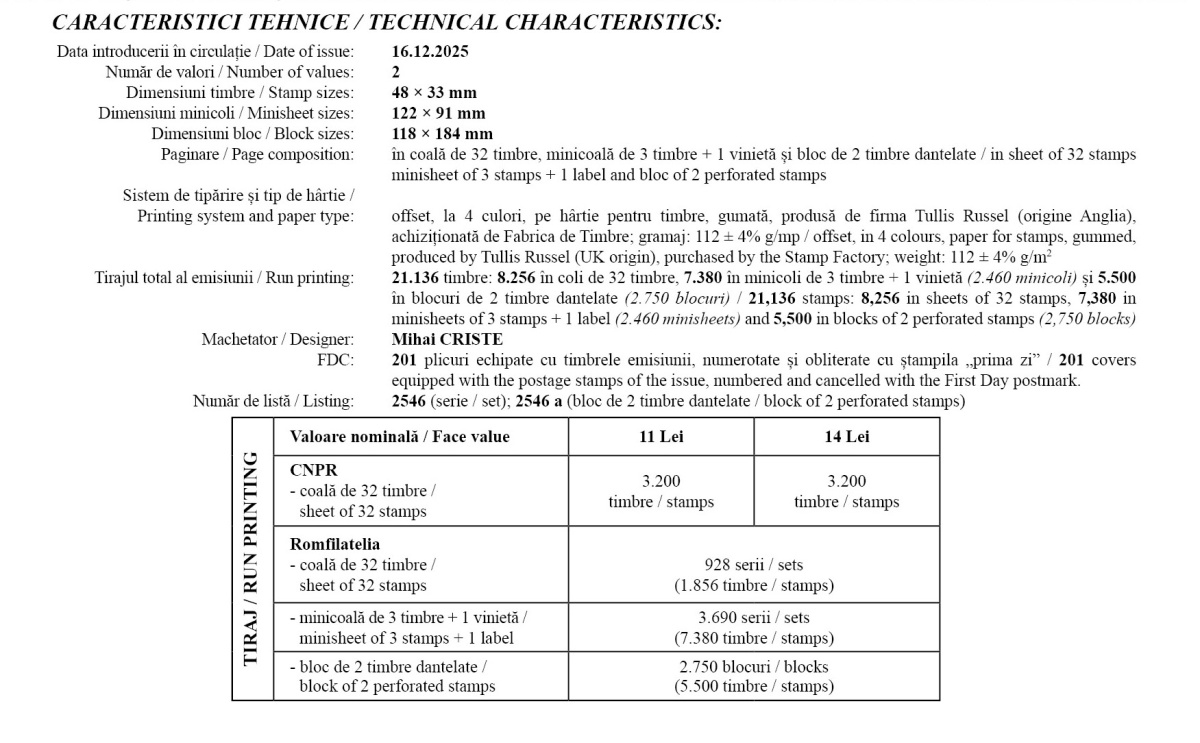
The issue consists of two postage stamps, a philatelic block of two perforated postage stamps, and a First Day Cover.
The founding of the Romanian Gendarmerie is recorded in the calendar of events on April 3rd, 1850, when, by princely decree, Grigore Alexandru Ghyka, the Ruler of Moldavia, approved the decision of the Public Divan and signed the ‘Law for the Reform of the Corps of Gendarme Servants’.
It is fitting that we respectfully recall the founder of the Romanian Gendarmerie, whose earthly remains were repatriated after 168 years and laid to rest in the Palace of Culture in the city of Iași, the historic Capital of Romania.
During the reign of Alexandru Ioan Cuza, the Gendarmerie underwent an extensive process of modernization and was removed from the administration of the Ministry of Internal Affairs (then called in Romanian Ministerul Trebilor din Lăuntru – the Ministry of Domestic Affairs), being placed under the direct subordination of the Ministry of War, with the status of a permanent military force.
During the War of Independence of 1877, as well as in the two World Wars, the Gendarmerie played an important historical role, both as a combat force and as a public order force.
It is worth noting that after the law enacted by Grigore Alexandru Ghyka, the legislation (inspired by French legislation) adopted in 1893 and 1929 fully clarified the role, place, and organization of the Rural Gendarmerie. The legislator in 1893, Lascăr Catargiu, placed particular emphasis on maintaining public safety, accompanied by strict observance of the law.
In 1949, as a result of the organizational changes imposed by the communist regime, the Gendarmerie lost a significant part of its responsibilities, being replaced by the Security Troops of the Ministry of Internal Affairs. The Rural Gendarmerie was subordinated to the General Directorate of the Militia.
The restructuring of the institution became possible after 1989, on the foundations of the rule of law, through the development of new concepts regarding the place and role of internal security forces. Reorganized, equipped, and trained in line with similar European forces, the Gendarmerie is now capable of assuming the responsibilities incumbent upon Romania as a member of the European Union.
At the central level, the Romanian Gendarmerie is coordinated by the General Inspectorate of the Gendarmerie. The elite unit, the ‘Vlad Țepeș’ Special Intervention Brigade, composed exclusively of professionals, carries out duties related to the restoration of public order and counter-terrorism operations throughout the country.
By being accepted as a full member of the International Association of Gendarmeries and Police Forces with Military Status (FIEP), the Romanian Gendarmerie acquires a European vocation, and the missions carried out under the aegis of the UN are the clearest proof of the professionalism of gendarmes, trained and educated to serve as providers, guarantors, and defenders of the rule of law and democratic principles.
It is worth highlighting that the activity carried out by the Romanian Gendarmerie, both nationally and internationally, has led to the recognition of the institution’s capabilities and the professionalism of its gendarmes by national and international bodies, as well as by Romanian citizens, the main beneficiaries of the services provided by the institution.
In this anniversary year, the Romanian Gendarmerie, a modern elite corps, presents itself as a public order force that is reliable, credible, politically impartial, and ready at any moment to carry out its entrusted missions flawlessly, being perceived as a fundamental pillar of public safety and order.
Romfilatelia thanks the leadership of the Romanian Gendarmerie and to the specialists within the National Archives of Romania and the Peleș National Museum for the documentary support provided in the development of this postage stamp issue.